

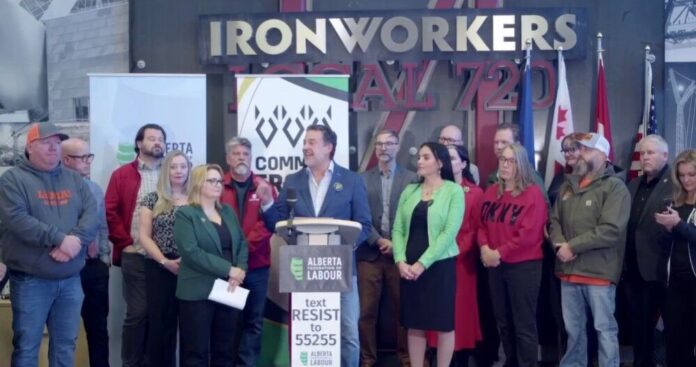

A general strike in Alberta is being discussed. On Wednesday, Oct. 29 Alberta Federation of Labour President Gil McGowan announced that union and labour leaders across the province are actively working toward that option.
McGowan says Premier Danielle Smith’s decision to invoke the notwithstanding clause in Bill 2—removing key democratic and constitutional rights from teachers—has galvanized unions in Alberta and beyond. He believes the fight ahead isn’t just about teachers or bargaining rights but about protecting democracy and the future of the province.
Workers mood
To understand the mood among workers, McGowan points to the United Food and Commercial Workers Local 401, Alberta’s largest private sector union. On Tuesday, Oct. 28 a survey of its 30,000 members—who work in grocery stores, warehouses, and meatpacking plants—found that:
- 90 per cent support the teachers
- 78 per cent support a general strike
- 69 per cent are willing to participate in one
“So that is the sentiment that I’m hearing from union leaders, union activists and individual workers across this province,” McGowan says. “They’re fed up with wages that haven’t kept up with inflation. They’re fed up with empty rhetoric from politicians who promise action on the affordability crisis but offer no real action. They’re fed up with a system that is clearly and increasingly rigged against them, and now they’re fed up with a government that is using its legislative power to silence workers and stop them from standing up for themselves.”
Solidarity Pact
The unions involved are signatories to the Solidarity Pact, which represents 350,000 working Albertans, notes McGowan. The pact is a commitment to stand together in the face of attacks from governments or employers.
“We are going to make the Solidarity Pact mean something. Over the coming weeks and months, every one of the Common Front unions will begin the process of talking to their members about our new priority, which is to protect our rights and our democracy by toppling this government.”
McGowan explains, “Every one of those unions will begin the process of engaging its members around things like recall and initiative campaigns, and yes, every one of those unions will begin the process of talking to their members about the possibility of a general strike.”
He says the path towards a general strike is to organize something that will be so big and effective that it will be unstoppable, but to do that and be successful, the internal democracy of all the unions involved needs to be respected.
Literary inspiration
Referencing activist Jane McAlevey, McGowan says there can be no shortcuts when it comes to organizing a general strike in Alberta.
“No one is coming to our rescue; it is up to us, and to quote poet June Jordan, we are the ones who we’ve been waiting for. In this fight, unions have a special responsibility,” he says. “So, we won’t just be striking against something, we will be striking and protesting in celebration and support of an agenda that is actually a worker agenda.”
McGowan adds it has been more than 100 years since there was a general strike in the prairie provinces. The last general strike held in the west was in British Columbia in the 1980s.
“But here in Alberta, to the best of my knowledge, there has never been a province-wide general strike before. So if we’re going to do this, we’re going to do it up big, and that means time for democratic discussions with our organizations. It means time for organizing.”
Building support
The labour leader continues, “Frankly, it also means that we need time for reaching out to allies and reaching out to workers who are not in unions. Because there are risks and we saw with the teachers that this is a government that is willing to impose, to use the heavy hand of government, to strip workers of the ability to come together and exercise their collective power.”
He adds that if the strike is to move forward, it needs to be so big and so widely popular that those taking part are defended by the size of the movement because they will not be able to arrest 250,000 workers, 350,000 workers or 450,000 workers.
“There isn’t room in our jails. There aren’t enough resources within our legal system to process arrests and fines. We have to build to the point where it’s so big that we protect ourselves by standing with each other, and that takes time.”
McGowan says that over four days, what they are calling the Ready to Resist List has nearly 30,000 people on it.
With files from: Kass Patterson – Vista Radio


