

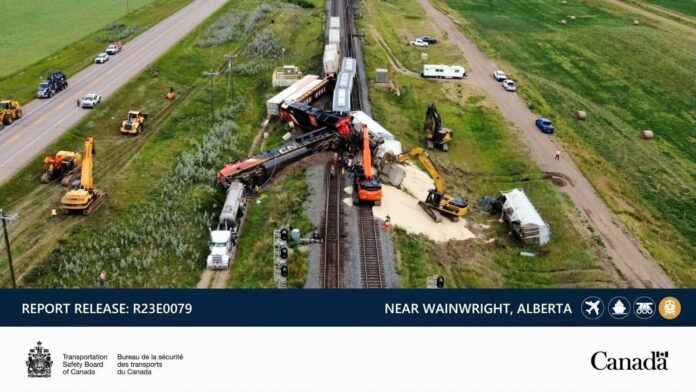

The Transportation Safety Board of Canada (TSB) is recommending that Transport Canada conduct regular audits of railway companies’ medical fitness assessments for employees in safety-critical positions following a train collision near Wainwright that investigators say may have been linked to a crew member’s medical condition.
The recommendation stems from a TSB investigation into an Aug. 8, 2023 collision involving two Canadian National Railway trains near Wainwright. The board says stronger oversight is needed to ensure railway companies are properly assessing employees whose medical conditions could affect their ability to safely operate trains.
What happened?
The collision occurred when a westbound CN freight train passed a stop signal and struck another CN train that was pulling out of Wainwright Yard.
The crash caused two locomotives and two intermodal rail cars from one train to derail, along with six sand-loaded rail cars from the second train.
No public injuries were reported, but investigators determined the collision occurred after the train failed to stop at a red signal.
Medical condition raises safety concerns
The investigation found the train was being operated by a trainee under the supervision of an experienced locomotive engineer.
According to investigators, the supervising engineer experienced a significant decline in cognitive functioning, affecting his ability to guide the trainee at a critical moment.
The TSB said symptoms observed before the collision were consistent with hypoglycemia, commonly known as low blood sugar. Hypoglycemia can cause symptoms such as confusion, difficulty concentrating, drowsiness and restlessness.
The locomotive engineer involved in the occurrence had Type 1 diabetes and required insulin treatment.
However, because no blood sugar testing or medical assessment was conducted immediately after the collision, investigators could not determine with certainty whether low blood sugar caused the impairment.
The trainee, meanwhile, was forced to make train-handling decisions without sufficient experience and did not apply enough braking to stop before the signal.
Investigators also found communication problems among crew members contributed to delays in deciding to stop the train.
Concerns over medical monitoring
One of the most significant findings involved the railway industry’s medical assessment process.
The TSB found annual diabetes assessments were missing from the engineer’s medical file for several years, while some assessments that were submitted were incomplete. Investigators said the railway accepted the incomplete information and therefore may not have had a full picture of the employee’s medical condition.
The board also noted that current railway medical guidelines allow higher average blood sugar levels than those recommended by Diabetes Canada.
For example, railway guidelines consider diabetes medically stable if a person’s A1C level remains below 12 per cent. Diabetes Canada recommends maintaining an A1C level of 7 per cent or less, and not higher than 8.5 per cent, to reduce the risk of serious complications.
The TSB pointed out that stricter medical requirements already exist in Canada’s aviation and marine industries, where Transport Canada directly oversees medical certification for pilots and mariners.
Recommendation for Transport Canada
As a result, the board is calling on Transport Canada to establish regular oversight activities to ensure railway companies are complying with medical fitness rules for employees working in safety-sensitive roles.
Investigators say without complete medical assessments, railway companies may not recognize health conditions that could affect an employee’s ability to safely perform their duties.
The report also noted that Transport Canada had not conducted any audits of CN’s compliance with railway medical rules in the 12 years leading up to the collision.
Safety changes already implemented
Following the crash, CN introduced new operating procedures requiring freight trains to reduce speed below the maximum allowable speed before passing certain signal indications.
The railway also reminded employees that conversations in critical operating zones should focus only on immediate train operations and encouraged junior crew members to speak up when identifying signals or safety concerns.
The TSB says the collision highlights the importance of both crew communication and robust medical monitoring systems in preventing future rail accidents.


